Save 20% on all courses!

How to Build an App Without Hiring a Developer: A Guide to AI-Driven Development
3/10/20267 min read
Introduction to App Development Without a Developer
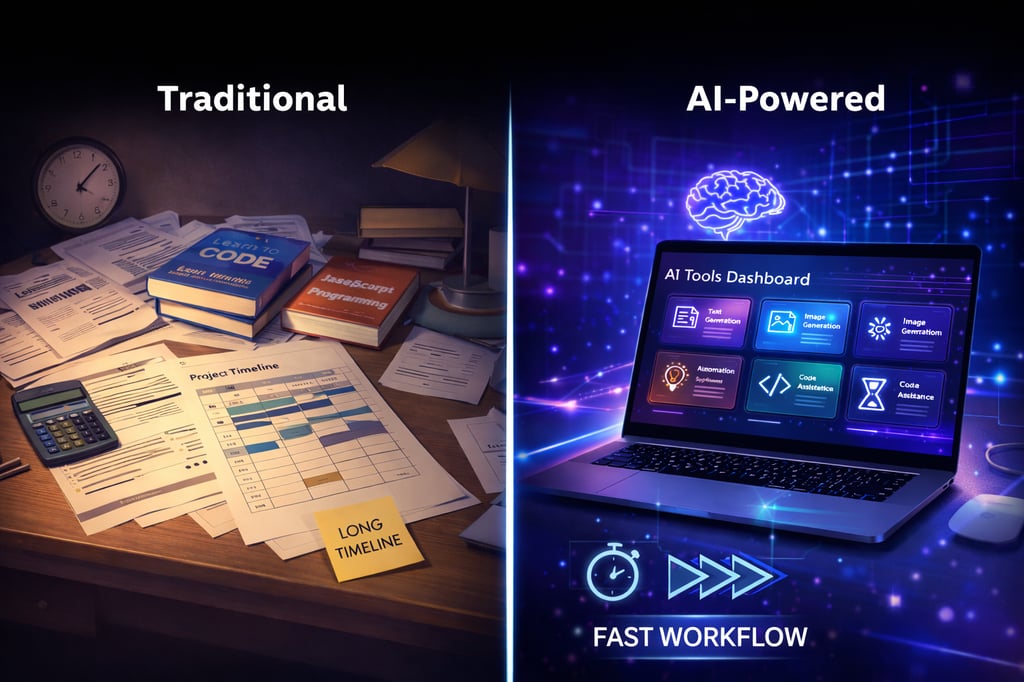
The landscape of app development has evolved significantly over the years, moving from a model that heavily relied on hiring skilled developers to one that empowers individuals and businesses to create applications independently. Traditionally, building an app required extensive programming knowledge and the financial burden of hiring expertise, which often posed a barrier for many aspiring creators. However, with the arrival of modern tools and technologies, this challenge can now be addressed through no-code and low-code platforms.
No-code and low-code platforms are designed to simplify the app development process by utilizing visual interfaces, drag-and-drop features, and pre-built components that eliminate the need for intense technical skills. These platforms leverage artificial intelligence (AI) to streamline tasks, making it possible for even those with limited experience to bring their app ideas to life. This shift has made app development more inclusive, encouraging innovation from diverse groups of people who previously felt constrained by their lack of coding knowledge.
Modernize your digital product workflow today.
The advent of AI-driven tools has further enhanced the capabilities of no-code and low-code development. By incorporating machine learning and data analytics, these platforms enable users to design interactive and responsive applications that meet modern user expectations. The integration of AI assists in automating various aspects of the development process, such as testing and deployment, thus reducing time and costs involved in launching new applications.
As we delve deeper into the possibilities offered by AI-driven development, it becomes evident that creating an app without hiring professional developers is not only feasible but increasingly practical. The democratization of app development through these innovative technologies empowers a new generation of creators, transforming ideas into reality while minimizing the technical barriers that once hindered progress.
The Role of AI in App Development
Artificial intelligence (AI) has emerged as a transformative force in the realm of app development, fundamentally altering how developers and businesses create mobile and web applications. By simplifying coding tasks through automation, AI enables individuals without extensive programming skills to engage in the development process. This democratization of technology offers a new avenue for innovation, allowing more people to bring their ideas to life.
One of the primary mechanisms by which AI simplifies app development is through machine learning algorithms. These algorithms can analyze vast amounts of data to identify patterns and make predictions, ultimately streamlining various development processes. For example, machine learning can assist in optimizing app performance by suggesting modifications that enhance user experience and engagement. This capability not only speeds up development but also ensures that the resulting application is more refined and user-centric.
Natural language processing (NLP) is another AI technology that significantly impacts app development. NLP empowers developers to create applications that understand and respond to user inquiries in natural language. This functionality is crucial for enhancing user interfaces, making them more intuitive and accessible. AI-driven chatbots, for instance, can provide real-time assistance within apps, improving user satisfaction and reducing the need for extensive customer support resources.
Furthermore, AI-driven Integrated Development Environments (IDEs) are increasingly popular among developers. These tools leverage AI technologies to offer intelligent code suggestions, debugging assistance, and automated testing features. By enhancing the design process and providing contextual help, AI-driven IDEs significantly reduce the time and effort required in app development, allowing users to focus more on their creative ideas and less on technical intricacies.
No-Code and Low-Code Platforms: An Overview
No-code and low-code platforms have emerged as transformative tools in the realm of app development, enabling individuals and businesses to create applications without extensive programming knowledge. These platforms cater to a diverse range of users, from entrepreneurs seeking to test ideas to enterprises aiming for rapid deployment of solutions.
No-code platforms are designed for users who may not have any coding experience. They provide visual development environments that allow users to drag and drop components, thus simplifying the app creation process. Bubble is one such popular no-code platform, known for its versatility and user-friendliness. Users can design fully functional applications while utilizing various pre-built templates and components, making it an excellent choice for those new to development.
Stop wasting time — build smarter.
On the other hand, low-code platforms bridge the gap between no-code solutions and traditional coding. They are aimed at developers who want to accelerate their workflows by automating repetitive tasks while still retaining the ability to write custom code when necessary. OutSystems exemplifies a robust low-code platform that combines rapid application development with a rich set of features. This platform allows users to build applications quickly while enabling professional developers to tweak or extend capabilities through code.
Adalo is another noteworthy option within the no-code space, allowing users to build apps that are both visually appealing and functional with minimal effort. It is particularly suitable for mobile app development, offering publish-ready apps in a matter of hours instead of weeks or months.
Ultimately, the choice between no-code and low-code platforms should depend on the specific needs and expertise of the user. No-code platforms are perfect for those who desire simplicity, while low-code solutions can empower more experienced developers to innovate quickly. The landscape of app development is evolving, making these platforms pivotal for those looking to build applications without the traditional barriers of coding.
Real-World Examples of Successful AI-Driven App Development
In recent years, numerous individuals and organizations have leveraged AI-driven development and no-code platforms to streamline their app creation processes. These technologies have enabled users without extensive coding expertise to design and deploy functional applications that address specific needs.
A noteworthy example is the development of a mobile application called "Grubhub for Dogs" created by a passionate entrepreneur. Employing no-code platforms such as Adalo and Bubble, this individual was able to build an app that connects local dog walkers with dog owners. The challenge was to create an intuitive interface that would allow users to request services seamlessly. By utilizing AI tools for user feedback analysis and data-driven decision-making, the entrepreneur managed to enhance app features progressively, significantly improving the overall user experience.
Another successful case comes from a small retail business that implemented an AI-driven inventory management application. Traditionally, the owner struggled with tracking stock levels and meeting customer demands efficiently. By using platforms like Airtable and Zapier, they developed a customized inventory management app that automated stock tracking and replenishment notifications. Throughout this process, they encountered hurdles relating to user interface personalization and data integration. However, by utilizing AI-assisted insights, they were able to refine their app, resulting in a 30% increase in operational efficiency and enhanced customer satisfaction.
These real-world examples illustrate how AI-driven app development can transform operations, facilitating new opportunities for engagement and efficiency. They serve as an encouragement for others considering similar paths, highlighting the potential of no-code solutions in today’s tech landscape.
Benefits of Building an App Without a Developer
Building an app without hiring a developer presents a myriad of advantages that cater to both individual creators and businesses. One of the most significant benefits is the substantial cost savings. Traditional app development often involves significant financial investment for hiring skilled developers, which can be a barrier for many entrepreneurs and small businesses. By leveraging AI-driven tools and platforms, users can minimize expenses and allocate budget resources more efficiently.
Additionally, creating an app independently can lead to a quicker time-to-market. Without the dependency on a developer's schedule, individuals can develop and launch their apps in a timeframe that suits their needs. This agility can be critical in responsive environments where market demands shift rapidly, allowing creators to seize opportunities without unnecessary delays.
Control over the development process is another considerable advantage. When individuals build their apps, they retain complete authority over decision-making and design choices. This level of control enables the incorporation of personal vision into the app, ensuring that the final product is closely aligned with the creator’s original intent. Moreover, direct involvement in the development leads to hands-on experience, which can be immensely beneficial for future projects.
The ability to iterate and adapt the app based on user feedback is crucial in today's app landscape. When developers maintain oversight, they can quickly implement changes that enhance user experience, thereby fostering satisfaction and engagement. Innovation and creativity can flourish when users are free to experiment with app design and functionality. As individuals navigate various AI tools, they can push the boundaries of traditional app creation, leading to unique outcomes that may not have been realized in a more structured development environment.
Challenges and Considerations when Using AI Tools
As the trend toward AI-driven development and no-code platforms gains traction, prospective developers must navigate several challenges associated with these technologies. One significant limitation is the functionality offered by many AI tools. While they provide impressive capabilities for simple applications, complex functionalities often require deeper technical involvement, which might not be achievable through automated means. It is essential to have a clear understanding of what can and cannot be accomplished with an AI tool to set realistic expectations from the outset.
Another consideration is scalability. While a no-code or low-code approach may facilitate the rapid development of an application, the initial design may not always accommodate future growth. For businesses with plans for extensive scaling, reliance solely on AI development tools can lead to performance bottlenecks or limitations in customizing features. To mitigate this challenge, developers should prioritize scalability during the design phase, ensuring that the architecture allows for growth and future enhancements.
Understanding the underlying technology is also critical for successful app development. Although AI tools greatly simplify the development process, this can create a disconnect between the developer and the underlying logic of the application. It is advisable for non-technical users to familiarize themselves with basic programming concepts and the logic that drives the chosen AI tool. This knowledge will empower them to troubleshoot issues effectively and make informed decisions regarding their app's functionality.
To minimize these challenges, it is recommended to choose the right AI platform that aligns with your development needs and to actively engage in forums or communities where shared experiences can provide additional insight. Best practices include initially developing a prototype to identify potential hurdles and refining the app's functionality based on user feedback before a full-scale launch. Taking these steps can significantly enhance the probability of successful app development using AI-driven tools.
Further Learning: Recommended eBook on AI and App Development
For those eager to deepen their understanding of AI in app development, we recommend exploring the eBook titled "AI-Powered App Development: A Comprehensive Guide." This resource is meticulously crafted for individuals who wish to leverage artificial intelligence to create their applications without the need for extensive programming knowledge or hiring a developer.
The eBook covers a variety of topics, including the fundamentals of AI technology, its practical applications in app development, and step-by-step processes for using AI-driven tools. Readers can expect to learn about how AI algorithms can streamline development tasks, automate repetitive processes, and enhance user experience through data-driven insights. It also delves into various AI platforms available, showcasing their features that developers can utilize to create functional apps effectively.
Additionally, the EBook features real-world examples that illustrate the successful integration of AI in app projects. These case studies provide readers with practical insights and inspiration as they consider their own app development journeys. Furthermore, the guide includes tips on best practices for selecting the right AI tools based on specific project needs, allowing readers to make informed decisions when embarking on their app creation endeavors.
By investing time in this informative eBook, aspiring app creators will not only expand their knowledge about AI technology but also gain valuable skills that are increasingly vital in today's tech landscape. Ultimately, this resource serves as an indispensable asset for individuals aiming to build apps independently, empowering them to understand the process and harness the benefits of AI effectively.
Digital Outreach Mastery
Contact
info@diigitaloutreachmastery.com
© 2026. Digital Outreach Mastery - All rights reserved.